
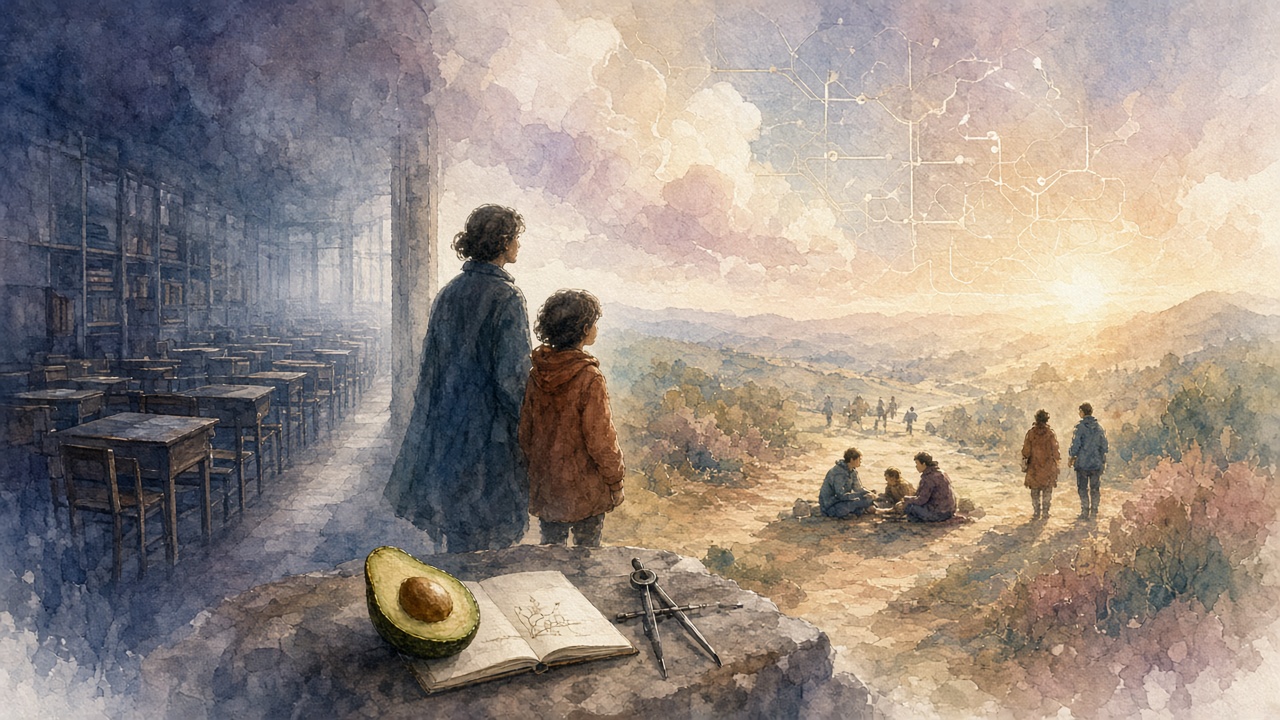
We are facing a profound transformation of the paradigms on which we have built our society, particularly with regard to work, education, knowledge, and the meaning we give to our human capacities.
Artificial intelligence does not simply represent a new technological tool. Its development is calling into question the reasons why we learn, the skills we consider valuable and, above all, the way we prepare people to take part in the world.
For a long time, education has been organized around a relatively simple promise: to devote a significant number of years to acquiring knowledge and skills that will later make it possible to practice a profession, earn an income, and build an economically stable life. Academic preparation thus became a prescribed path toward a future that was also prescribed.
That promise, however, is beginning to lose its foundation.
The transformation of the value of knowledge
Artificial intelligence is reaching capacities that until recently we considered the province of extraordinarily well-prepared people. Activities that required years of study, experience, and specialization can now be carried out, wholly or in part, by automated systems.
This is especially visible in disciplines such as software development, where the capacity to produce technical solutions is beginning to give way to the capacity to understand problems, formulate purposes, evaluate results, and intelligently guide the work of machines.
Human value no longer resides exclusively in knowing how to execute a task, but in understanding which task is worth doing, why it should be done, and what result is truly desirable.
This shift reveals a fundamental question: much of the work we do as human beings is alien to our own desires.
Automation has accompanied humanity from its origins. Every tool we have created has made it possible to reduce the effort needed to reach certain results. From a stone used to make a task easier to today’s systems of artificial intelligence, there is a historical continuity in our search to free human time and effort.
But the present transformation has a particular quality: we are no longer automating only physical effort or mechanical activities, but also a growing part of intellectual work.
This forces us to reconsider, at a deep level, what it means to prepare for life.
Education and the limits of conventional learning
Even before the development of artificial intelligence, some of the most extraordinary human capacities could hardly be developed through conventional educational systems.
The history of computing and of hacker communities offers a particularly interesting example.
During the last decades of the twentieth century, some of the most capable people in computer security came from unconventional learning paths. Their skill was not only the result of technical knowledge, but of a combination—difficult to reproduce—of curiosity, experimentation, diverse experiences, and an extraordinary capacity to think outside established patterns.
Developing this kind of thinking means learning to look at tools beyond the functions for which they were created.
We can imagine an educational experience in which, instead of handing a child a spoon to eat soup, we provide objects that were not designed for that purpose. The challenge is to discover how to solve the problem with the resources at hand.
An avocado, for example, can become food, and its skin an improvised spoon.
What matters is not the particular solution, but the experience of discovering that objects, ideas, and forms of knowledge are not necessarily limited by their conventional uses.
This way of thinking is indispensable for creativity, for innovation, and for the capacity to recognize possibilities that other people do not notice.
It is no accident that many people of extraordinary ability in technological disciplines have also developed broad and diverse interests: sports, music, travel, human relationships, the arts, and different ways of exploring the world.
Their capacity does not come from specialization alone, but from a deeply curious relationship with reality.
Conventional education, by organizing knowledge into subjects, programs, assessments, and prescribed objectives, often leaves little room for this kind of learning.
And now, when a significant part of technical capacities can be reproduced by artificial systems, the limitations of that educational model become even more evident.
Artificial intelligence and the limits of patterns
Current systems of artificial intelligence have an extraordinary capacity to identify relationships, recognize patterns, and produce answers from enormous quantities of information.
There is, however, a fundamental difference between identifying what is probable and deciding what is desirable.
Artificial intelligence can help us find answers, but the question of what world we want to build remains deeply human.
Artificial intelligence models learn statistical regularities and can combine knowledge in surprising ways. Human innovation, however, often consists precisely in questioning what seems obvious, challenging dominant practices, and exploring paths that at first appear improbable.
The great social, scientific, and cultural changes often are born of that break with convention.
That is why the capacities that take on a renewed importance are judgment, creativity, understanding, sensitivity, and the ability to connect experiences and forms of knowledge that seem distant from one another.
Above all, our capacity to decide what we want acquires value.
And here one of the greatest contradictions of our educational system appears: the capacity to discover and construct our own desires is precisely one of those we have cultivated the least.
For years we have accustomed children and young people to follow programs defined by others, to meet external objectives, and to direct their efforts toward future rewards.
We have taught them at length what they must learn, when they must learn it, and how to demonstrate that they have learned it, but we have left them little room to ask themselves what they wish to know, and why.
From compulsory knowledge to learning by will
If the production of knowledge and the execution of many tasks cease to depend exclusively on human effort, the central question of education necessarily changes.
It is no longer enough to ask what a person needs to learn in order to get a job.
We must ask what they need to experience in order to understand the world, recognize their capacities, discover their interests, and build a life that has meaning for them.
This does not mean abandoning academic knowledge or dismissing technical preparation.
It means transforming the relationship we maintain with learning.
A person can devote years to the study of mathematics, music, philosophy, programming, or any other discipline. But there is a profound difference between doing so out of obligation, out of an economic promise, or out of a genuine desire to understand, create, and discover.
Learning driven by the will transforms the educational experience.
Learning ceases to be only a means of reaching a future reward and becomes also a way of living.
Curiosity, exploration, and experimentation cease to occupy a secondary place and become central elements of human development.
To cultivate these capacities we need real experiences: to touch, to build, to make mistakes, to converse, to collaborate, to face difficulties, to discover solutions, and to relate directly to the world.
We need to recover the value of making things with our hands, of sharing spaces, and of building knowledge together with other people.
It is particularly significant that, in an age characterized by technological sophistication, a fundamental response to our educational needs may be found in something as ancient as human contact.
To meet again, to touch one another, and to touch the world.
Community as a space of transformation
The history of the free software movement offers another important experience for understanding how knowledge and human collaboration can be organized.
Free software communities arose around principles that defended the freedom to study, use, modify, and share knowledge and its applications.
Their development showed that people distributed across the world could collectively build extraordinarily complex systems without depending exclusively on traditional hierarchical structures.
One of the practices associated with these communities is do-ocracy, a form of organization in which initiative and action play a central role.
Whoever identifies a need and has the capacity to contribute can begin to do so. Solutions are put into practice, shared, reviewed, and improved collectively.
Instead of concentrating all the energy on deciding who has the authority to act, the value of effective participation is recognized.
These experiences show that learning, creation, and social organization can be built around shared interest, collaboration, and the will to contribute.
They also reveal that economic livelihood need not constitute the initial purpose of every human activity.
When an initiative finds its roots in authentic needs, in people’s interests, and in a committed community, it can develop forms of organization and sustainability that emerge from its own growth.
Placing the economic as the dominant purpose from the beginning can limit the possibilities of exploration and reduce the value of human relationships to their capacity to produce income.
On the contrary, beginning with purposes, needs, desires, and bonds can open paths that could not have been anticipated from a purely economic plan.
The breaking of social paradigms
Great technological changes do not transform only the tools we use. They also modify institutions, economic relationships, and the ideas we consider natural.
The Industrial Revolution profoundly altered the organization of work and the social structures of its time.
Much later, digital photography transformed an industry that for decades had depended on the manufacture of film, on developing, and on photographic printing.
In both cases, established economic systems had to transform because the conditions that justified their existence had changed.
The magnitude of an institution does not guarantee its permanence when the conditions that sustained it disappear.
Something similar may happen with our educational systems.
The fact that a society has, for generations, organized human formation around a certain number of years of schooling, curricular programs, degrees, and certifications does not mean that that model can indefinitely retain its meaning.
When the capacities that justified a long academic preparation can be developed, complemented, or carried out in radically different ways, the entire system is exposed to an inevitable revision.
This transformation does not imply that knowledge loses its value.
It implies that the reason we seek it changes.
Education can no longer be justified solely as a process of preparation for performing certain productive functions.
It needs to find its way back to a deeper purpose: the development of human beings capable of understanding, choosing, creating, relating, and taking a conscious part in the construction of their reality.
The rediscovery of human desire
There is a question that takes on extraordinary importance in this new landscape:
What do we want to do with our lives when we no longer need to devote so large a part of them to preparing ourselves to execute tasks that a machine can perform?
This question can be disconcerting, because for generations we have built a good part of our identity around our professions and productive capacities.
We are what we know how to do, that for which we studied, and the function we perform within society.
But when a machine can reproduce a growing part of those functions, the possibility appears of reconsidering our identity from a different perspective.
Perhaps a person’s value should not be sought mainly in what they can produce, but in their capacity to experience the world, build bonds, develop sensitivities, formulate questions, and find purposes.
The desire to learn does not disappear when an academic obligation or an economic reward ceases to exist.
On the contrary, it can manifest itself in freer and deeper ways.
A person may want to learn to play an instrument simply to discover what music they are capable of creating. They may explore a craft to experience what it means to transform materials with their hands. They may study philosophy to better understand their own existence, or approach a scientific discipline for the pleasure of discovering how reality works.
In all these cases a motivation appears that does not need to be justified by an immediate economic utility.
It is the desire to know oneself, to explore one’s own capacities, and to encounter the world.
And perhaps that is one of the great opportunities opened by the present technological transformation.
Not simply to produce more, work faster, or make our institutions more efficient, but to recover a dimension of human experience that has been subordinated to the demands of productivity.
Toward a new understanding of education and of life
The paradigm shift we are beginning to experience does not consist only in replacing workers with machines or incorporating artificial intelligence into classrooms.
It consists in questioning a social structure that for a long time has tied the value of knowledge to its capacity to generate income, and the value of people to their productive capacities.
If machines can take on an ever greater part of the tasks needed to sustain our material organization, then we have the opportunity—and the responsibility—to ask ourselves how we want to use that possibility.
We can try to preserve the same educational and labor models, using technology only to increase productivity.
Or we can take advantage of this transformation to reconsider what it means to learn, to work, and to develop as human beings.
This requires restoring a central place to human contact, to community, to creativity, to direct experience, and to the freedom to explore.
It requires recognizing that learning should not be only a preparation for life, but an inseparable part of it.
And, above all, it requires recovering questions that too often we have replaced with instructions and external expectations:
What do I wish to know?
What am I capable of doing?
What happens if I devote my time to developing this skill?
What can I discover when I explore something I do not yet understand?
What do I want to build together with other people?
Who am I, and who do I want to become?
Perhaps the deepest change is not technological, but human.
Artificial intelligence is forcing us to revisit what we considered exclusively ours. But in doing so it can also help us rediscover something that no promise of productivity should displace: our capacity to desire, to choose, and to find meaning in the experience of living.
The challenge is no longer only to learn to do what the world needs. It is to discover once again what world we want, and what we wish to do in it.
 English
 Español
Leave a Reply